

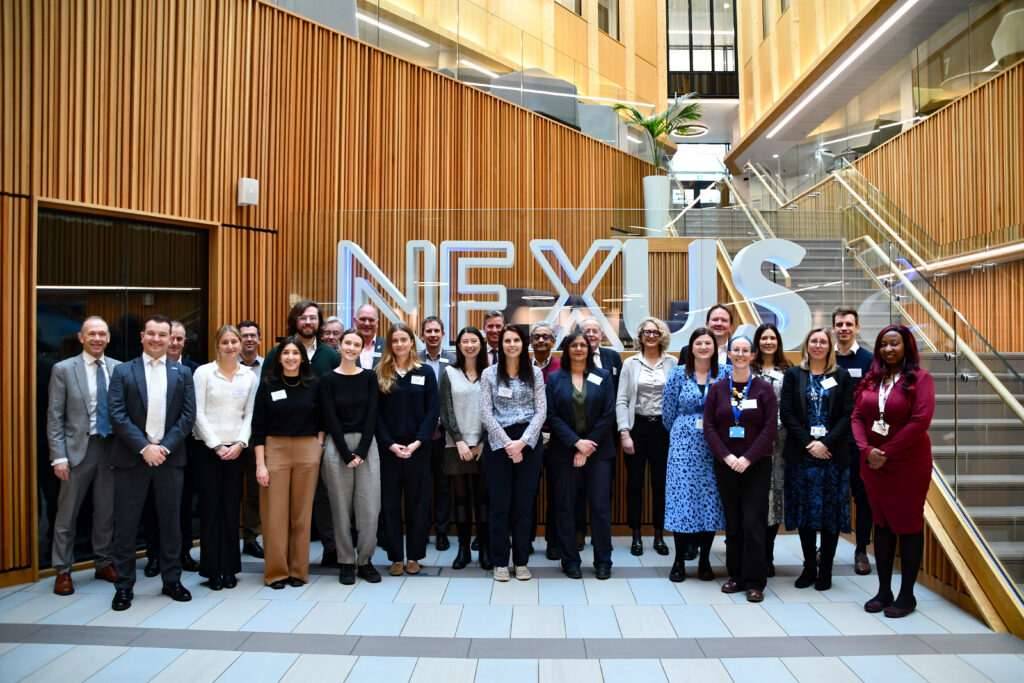
City and regional leaders this week welcomed HM Treasury to showcase how Leeds’ £40m NIHR infrastructure is accelerating national ambitions to tackle health inequalities and position the UK as a global leader in life sciences.
The high-profile visit from the Treasury’s Growth and Resilience team began at the University of Leeds’ innovation hub, Nexus, with a roundtable highlighting how the city’s world-leading research and innovation are driving real-world impact.
Director of the NIHR Leeds Biomedical Research Centre (BRC) Philip Conaghan, chaired the discussion, where a range of experts from academia and industry outlined how Leeds is driving progress through its pioneering, partnership-powered NIHR@Leeds infrastructure.
This includes the Leeds BRC – an international centre of excellence hosted by Leeds Teaching Hospitals NHS Trust in partnership with the University of Leeds and the University of York. The BRC supports translational research across antimicrobial resistance and infection, cardiometabolic disease, haematology, musculoskeletal disease, pathology and surgical technologies.
BRC Director Philip Conaghan described how the city has developed musculoskeletal expertise and facilities not available anywhere else in the world — from the prevention of immune diseases through blood tests and ultrasound, to novel therapies including a first positive trial of a new class of analgesics.
Attendees also heard how the BRC’s work with innovators like Atlas Endoscopy is revolutionising healthcare. Based in state-of-the-art facilities at Nexus, attendees heard how the clinical stage start-up has developed a groundbreaking robotic colonoscopy device, significantly reducing pain for patients and offering clinicians and unmatched precision tool to improve efficiency and uptake of life-saving procedures.
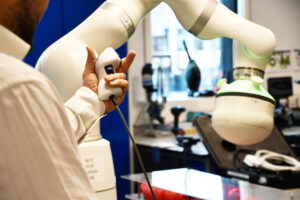
As a top UK health innovation location, and globally-leading healthtech hub, the visit showcased how Leeds uniquely connected and high-performing ecosystem provide the ideal conditions to translate world-class research into commercial success.
Fiona Bolam, Chief Officer (Economy & Skills) at Leeds City Council described how a strong and resilient £36bn economy in Leeds is outpacing national growth. Health represents one of the three key sectors fuelling this standout growth, in a region which is UK’s second largest finance and professional services centre.
At its heart, Leeds is home to 40 national and international banks, and in its vibrant and connected city centre, the Northern Square Mile brings together businesses, regulators, world-class universities, international banks and major institutions, all in one place.
Nick Plant, Pro-Vice-Chancellor (Research & Innovation) at the University of Leeds, explained why Leeds has established itself as a top city for start-ups, scale-ups and spin-outs. As one of the top five research delivery centres in the UK, halving clinical trial set-up times, the city connects talent, technology and enterprise in ways that few places can.
With one of the UK’s most interconnected health innovation ecosystems, the city’s £40m NIHR infrastructure comes together as NIHR@Leeds, with academic researchers, clinicians and industry innovators increasingly collaborating to cover the entire health research journey, taking new discoveries from ‘bench to bedside’.
Delegates heard how the NIHR Leeds Clinical Research Facility (CRF) works with industry, research councils and charities to run more than 100 early-stage clinical trials each year, pioneering new treatments, with a tour of facilities at St James’s University Hospital – one of five Clinical Research Facility sites across the Trust.
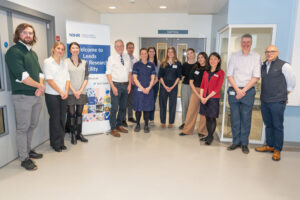
Nationally-recognised for its leading sustainability initiatives, the NIHR Leeds HealthTech Research Centre showcased its work to support innovators developing cutting edge-solutions, such as HistoSonics, Inc.’s non-invasive, sonic beam therapy to destroy liver tumors.
The visit further highlighted world-leading work across the national NIHR Yorkshire and Humber | NIHR RDN, hosted in Leeds, and the NIHR Applied Research Collaboration Yorkshire & Humber (ARC YH).
Amber O’Malley, RRDN Network Director explained how research participation in Yorkshire and Humber was higher than the national average, with more than 100,000 people taking part in 2024-25. This includes trials of an innovative ‘sponge on a string’ test, which detects up 10 times more cases of precursor to oesophageal cancer and costs £127 less than an endoscopy, signalling greater effectiveness and value for money.
Similarly, ARC YH Co-Director Professor Andy Clegg explained how a global-first, made-in-Leeds automated digital tool to support routine frailty identification could be used to standardize referral pathway for falls prevention nationally, saving the UK £150 million annually.
Leeds and the region demonstrated how an outstanding track record transforming care repeatedly attracts national and international acclaim, and how it continues to raise the bar through unparalleled collaboration.
The visit concluded with a visit to St James’ University Hospital, with a tour of the state-of-the-art NIHR Leeds Clinical Research Facility, just one of the five CRF’s at Leeds Teaching Hospitals. As part of this, delegates met with Executive and Senior Leaders to hear about the strength and scale of world-class clinical research at the Trust – one of the UK’s largest teaching hospitals, delivering impact and patient benefits across the region and beyond.
Director of the BRC, Professor Philip Conaghan, speaking on behalf of the NIHR@Leeds infrastructure, highlighted how, in Leeds, powerful partnership working is improving people’s health and making investment go further, leading the national priorities to shift care from hospital to community, analogue to digital and treatment to prevention:
“We were delighted to welcome HM Treasury’s Health and Growth Team, which was an invaluable opportunity to showcase how, together, NIHR@Leeds is turning bold ideas into real-world change.
“As the government’s go-to location to drive the national health mission, we have a strong track record of turning world-leading research into reality, tackling health inequalities and leading national change at pace.
“Leeds is one of the UK’s top five research delivery centres, halving trial set-up times, and a top city for attracting research funding. We’re incredibly proud to show how, in Leeds, powerful partnership makes funding go further, delivering real returns and real impact – locally, nationally and globally.”
Find out more about Leeds internationally renowned ecosystem here.