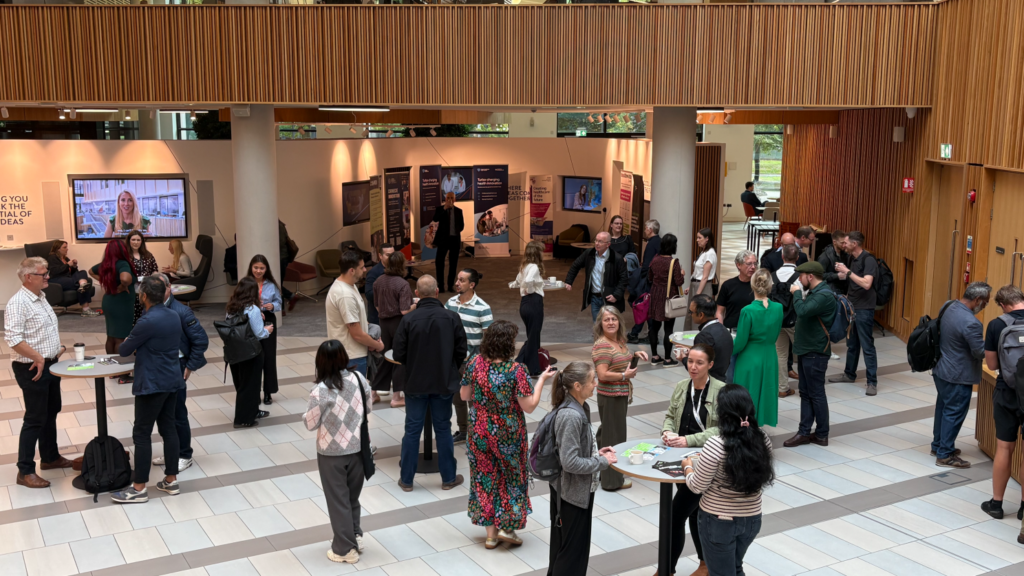
During our ‘You Bet’ session, held at Nexus Leeds this September, we heard from four expert panels, chaired by Health Innovation Leeds Partnership Director, Kate Lodge.
We discussed how to put people and system needs at the heart of innovation, where the greatest opportunities for collaboration lie, how to navigate the realities of regulation, adoption and scaling, and the support available across the region to help innovators succeed.
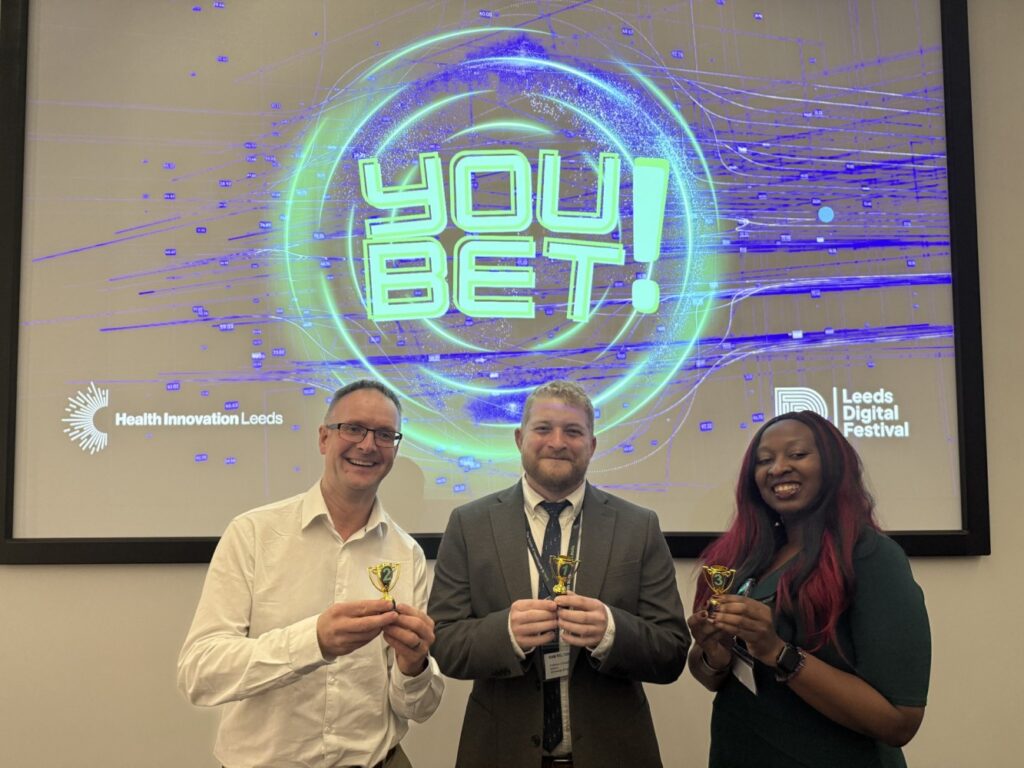
And throughout the event, we asked attendees to place their bets, answering a selection of fastest-finger-first questions ranging from the strategic to the surprising – and, occasionally, the silly. You’ll find some of these fun facts throughout the article, along with top takeaways and resources.
Digital first doesn’t mean digital only
The discussion rightly began with patients, communities and what our system and society needs.
Tatum Yip, Project Manager at Healthwatch Leeds, highlighted how Healthwatch has championed the use of digital technologies to help deaf people access GP services, after listening to their consistent calls for this support. In a major step forward, new interpreting contracts across many Leeds surgeries now include on-demand BSL interpreters to help people make an appointment.
But Tatum gave this advice to innovators:
“Remember, there’s always a group of people cannot access digital for whatever reason. Maybe they don’t want to. Maybe the confidence isn’t there. Maybe they don’t have the devices or easy access to WiFi.”
“While the city is taking a digital first approach, that doesn’t mean digital only.
“Innovators need to really think about the people who are vulnerable, those who are elderly, don’t speak English, or have disabilities and always think about an option for people who don’t use technology.”
In fact, almost a quarter of adults in the UK have “very low digital capability”, and Tatum pointed to the 2025 report ‘Keeping every door open: Ensuring access beyond digital in health and care’ as a helpful resource to support innovators to understand some of these groups.
Jason Broch, Medical Director & Deputy Director of Integration NHS West Yorkshire Integrated Care Board (ICB), highlighted shared challenges across primary care, hospitals and community organisations: more people needing support, longer waits, and services struggling to keep pace with demand.
When we consider how new tech and AI can tackle these issues Jason noted:
“We’ve got to say: ‘this innovation may be great within an organisation, but where the real inefficiencies, the real poor experience happens, is in the interface between organisations as well’.”
Frank Wood, Chief Analytical Officer, Leeds Office of Data Analytics, described how Leeds’ linked health and care data provides a powerful way to understand people’s journeys across services, predict future health risks and reveal how factors such as housing, social care and wider living conditions influence health outcomes.
“We have what is a really novel information asset in the Leeds Data Model – a series of commonly pseudonymised linked health and care datasets.”
Leeds was one of the first places in the UK to link primary care data with adult social care data. Since then, the model has continued to evolve, bringing together increasingly rich sources of information and creating new ways to understand population health.
Working in partnership with Accenture, Leeds has been able to use predictive modelling to identify the likelihood of individuals developing long-term conditions within the next three years.
Top takeaways for innovators
Start with real people and real needs, designing solutions that improve access and outcomes without excluding those who cannot or choose not to use digital services. Innovation will deliver the greatest impact when it not only improves individual organisations, but also connects care across organisational boundaries and makes better use of data to understand need, tackle inequalities and target prevention more effectively.
Quiz time ❓
How many times is digital mentioned in the 10-year-health plan? 122
True or false: Leeds is mentioned in the 10-year-health-plan more times than London? True!
How many owls feature on the Leeds city crest? 3
A future built around neighbourhood health models
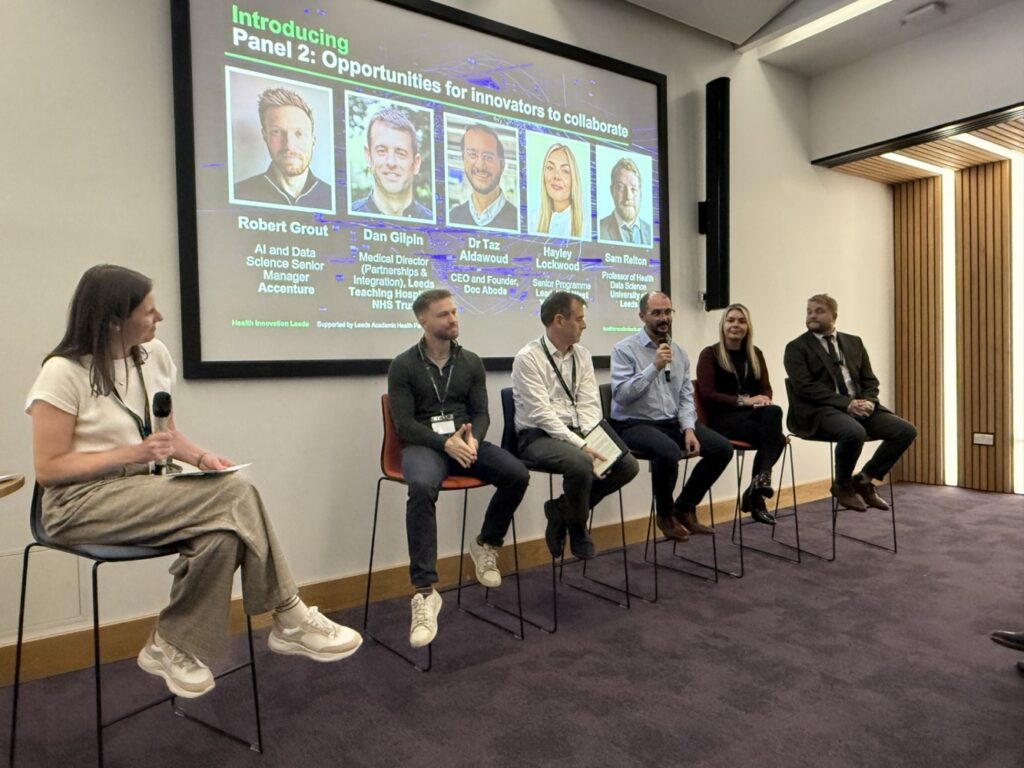
A panel made up of Dan Gilpin, Medical Director (Partnerships & Integration), Leeds Teaching Hospitals NHS Trust, Hayley Lockwood, Senior Programme Lead, NHS West Yorkshire ICB, Dr Taz Aldawoud, CEO and Founder, Doc Abode, Samuel Relton, Professor of Health Data Science, University of Leeds, and Robert Grout, AI and Data Science Senior Manager, Accenture explored how these challenges present opportunities for innovators to work hand in hand with the system.
For Dan, the conversation is bigger than digital transformation. It’s about redesigning the way healthcare itself is organised, with a future built around neighbourhood care – bringing together health, care and community support around people and places. As one of the pioneer sites for the National Neighbourhood Health Implementation Programme, Leeds is ideally placed to make this happen – and is already doing just that.
Through the city’s neighbourhood health model, Leeds is bringing together NHS services, social care, public health, housing and voluntary sector partners to work as connected local teams. The goal is that people experience more joined-up support, tell their story once, and receive coordinated care closer to where they live.
From his roles on both sides of the fence, GP and innovator Taz had some pragmatic tips for businesses: bear in mind that many frontline teams still rely heavily on familiar tools such as Word, Excel, WhatsApp and paper-based processes. That means successful innovation is often as much about fitting into the way people already work and helping them adapt to change as it is about the technology itself.
Hayley from the West Yorkshire ICB explained that strategic commissioners prioritise solving problems over adopting specific technologies:
“Rather than looking at individual organisations in isolation, how can we improve the coordination of care across organisational boundaries and between different professionals? It comes down to integrated working, enabling people from different organisations to contribute to a holistic understanding of a person’s needs.”
Top takeaways for innovators
focus on solving real challenges, whether that’s supporting staff to work more effectively, improving the experience of moving between services, or tackling health inequalities. The most valuable innovations start with a clear understanding of the problem and use technology and data as tools to improve outcomes, rather than treating technology as the solution itself.
Quiz time❓
How many times are neighbourhoods and communities mentioned in the 10-year-health-plan? 260 (that’s more than digital and AI put together)
What is the population of Leeds? Around 800,000 people
And what percentage of Leeds people live in areas that are in the top 10% most deprived nationally? More than a quarter
The power of data for proactive, preventative care
Prof. Sam Relton highlighted examples of how Leeds’ is paving the way when it comes to early intervention, using longitudinal health data to get a holistic picture of people’s health and looking at places where we might have intervened earlier to prevent poor outcomes
Sam described how the groundbreaking Electronic Frailty Index, built in Leeds, is used by GPs to assess elderly patients to help tailor their care – so that they avoid a serious fall:
“A powerful example of this in action is the partnership between the University of Leeds and Greater Manchester ICB, which identified people in their elderly population most at risk of falls and gave them stairlifts. This keeps people at home and independent for longer, of course, and it also reduces pressure on the hospital system. So it’s a win-win.”
Rob noted that Accenture is working closely with the Leeds Office of Data Analytics team in this very space:
“The work Sam’s talked about shows the impact of better risk prediction and earlier intervention capabilities. If you’re going to put stairlifts in people’s homes, you can’t afford to do it for everyone. You need an algorithm which will tell you which people are most likely to fall to make that cost effective.”
Sam also touched on an important topic for innovators – evaluating digital interventions and what the Medicines and Healthcare products Regulatory Agency (MHRA) call post-market surveillance.
In short, once these tools are deployed and in use, ensuring they remain fit for purpose and actually do the job they were intended to do. Sam noted that a current project at the University of Leeds is looking at how these tools drift over time and become more and more error-prone.
Sam signposted to the recent MHRA post-market surveillance guidance around monitoring AI and digital tools.
Rob discussed the potential to use how AI is increasingly acting as a “digital front door”, and has the potential to be a population health manager.
Pointing to research from Kings College London, Rob noted that 15% of the public have used AI chatbots for health advice instead of contacting a GP or other NHS service.
While Rob acknowledged AI’s potential to support care closer to home and help people manage their health more proactively, he also raised an important challenge: how do we retain the principles of the NHS – free at the point of use and equity in terms of access?
“At the moment many AI subscriptions are expensive, your ability to get good answers depends on your ability to ask good questions and communicate articulately.”
This brought us back to Tatum’s opening remarks and reinforced a crucial point for innovators: new technologies should help narrow health inequalities rather than inadvertently widening them.
Top takeaways for innovators
Focus on where you can help the system act earlier, not just more efficiently. There are big opportunities to use data, AI and predictive analytics to identify risk sooner, target support more effectively and show real improvements in outcomes. But building a successful product is only part of the challenge. Innovators also need to think about how solutions will be evaluated, make sure they continue to perform in the real world, and design for equity from the start.
Quiz time❓
Where can you find detailed ward-level data on population, housing, health and other key stats for areas across Leeds? The Leeds Observatory
What position does Leeds rank globally as healthtech hub? Top 3!
And that’s not all our region’s famous for …How many cups of Yorkshire Tea are drunk each day in the UK?10 million!
Regulation as ‘necessary friction’
Regulation may be seen as something that slows innovation down. The panel had a refreshing perspective to counter this. Regulation unlocks trust, and trust enables innovation to scale.
Without confidence in safety, effectiveness and governance, even the most promising technologies struggle to gain traction.
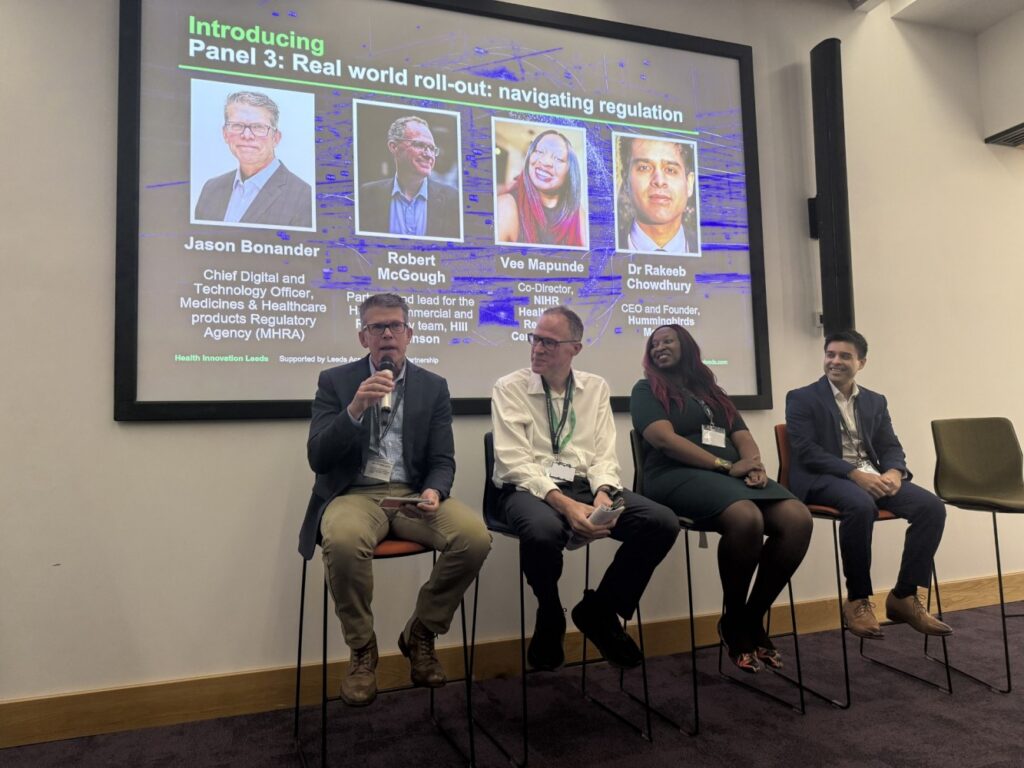
The panel comprised Jason Bonander, Chief Digital and Technology Officer, Medicines & Healthcare products Regulatory Agency (MHRA), Robert McGough, Partner, and lead for the Health Commercial and Regulatory team, Hill Dickinson LLP, Varaidzo (Vee) Mapunde, Co-Director, NIHR Accelerated Surgical Care HealthTech Research Centre Leeds, and Dr Rakeeb Chowdhury, CEO and Founder, Hummingbirds Medical.
Jason described regulation as “necessary friction” – essential for ensuring patient safety and clinician confidence in new technologies.
He encouraged innovators to engage with the MHRA early to understand whether their product falls within a regulated space. With the MHRA working on faster, more flexible routes for lower-risk innovations to reach the health and care system safely and at pace, there is a growing opportunity for developers to work alongside regulators and bring promising solutions into practice.
Jason also explained why the MHRA recently chose Leeds as the home for its new digital hub, pointing to the city’s vibrant innovation ecosystem, outstanding medtech sector and world-class NHS and academic expertise.
Vee introduced NIHR Health Tech Research Centres – which support the co-development of new technologies, helping innovators generate the right research evidence they need to resonate with the needs of the NHS.
“You’ve got to be solving a problem. Quite often, a solution might work really well in theory. It might work in a small organisation somewhere. But the NHS is not an organisation. It’s a system.
“So the first step would be for anyone looking at an innovation: is you really need to understand the sandpit you’re about to go and play in.
“There’s no point in just jumping into it without doing the homework and establishing if there is a real need, and that your product is solving a real problem.”
Vee urged innovators to understanding the mechanisms that the NHS uses to purchase, and to “follow the money.”
“You need to speak the NHS language. Rather than your projected sales or profit, the NHS is interested in outcomes for patients and the system: will it mean patients recover quicker from this particular condition? Will it reduce the amount of prescriptions and drugs somebody is getting?”
And the NIHR HRC is there to help, as Vee explained:
“You might have a technology that you think is for colorectal cancer, for instance, but it’s our job to tell you if that market is already crowded, and you may need to actually target it towards pancreatic cancer.”
Rob highlighted that some of the biggest barriers to scaling innovation are often not technical but practical. Many products succeed in pilot projects only to stall because there is no clear route for adoption or procurement once testing ends.
He also stressed the importance of protecting intellectual property early, and understand and comply with the strict requirements around the use, sharing and security of NHS data.
As a clinician and innovator, Rakeeb discussed the complexities of navigating regulatory pathways while developing Hummingbirds, a clinical oversight infrastructure tool.
The NHS treats all suppliers equally regardless of size, requiring small start-ups to meet the same rigorous assurance standards as large corporations like IBM – with Rakeeb suggesting different assurance tiers based on product scope could help ease the burden on smaller innovators.
These regulatory requirements might understandably feel overwhelming. Rob noted:
“In Leeds, we’ve got a really good ecosystem – when you look at things like the Propel programme, Health Innovation Leeds, and the HRC support Vee talked about, there’s a lot of help for innovators to really guide them through.”
And, the day’s final panel focused on just what support is on offer in Leeds and the region to help innovators navigate the path from idea to implementation.
Top takeaways for innovators
Engage early, solve a real problem, and don’t leave adoption to chance. Success depends not just on having a good product, but on understanding NHS priorities, regulation, procurement and data requirements from the outset. Regulation and evidence generation can help build the trust needed to scale, while a clear route beyond the pilot stage is just as important as the technology itself.
Quiz time❓
Which organisation is responsible for regulating medical devices in the UK? The MHRA
What can the NIHR Leeds HealthTech Research Centre help innovators with? Evidence generation, clinical evaluation and NHS adoption
Support on offer to supercharge success
“Get as much help as you can. You’re not going to do it on your own, and it’s hard.”
Advice from Dr Neville Young, Director of Enterprise and Innovation at Health Innovation Yorkshire & Humber summed up the message of the fourth and final panel session.
Nev said:
“Build your network.”
“You need to be able to engage with as many people in the system as possible to work out what your best route of attack is. It might not actually be who you think it is. You might think you want to sell primary care. You might actually end up selling it to help social care to the council.”
Top takeaways for innovators
Build your networks, explore the support on offer and don’t go it alone.
The panel, including Natalie Allen, Head of Business Partnerships, Leeds Beckett University, Moninder Bhogal, Business Development and Innovation Manager, Leeds Teaching Hospitals NHS Trust, Alexis Twigg, CEO and Founder, Care Networx, and Brad Ebanks, Inclusive Economy Manager, West Yorkshire Combined Authority, showcased the partners and programmes supporting local innovators.
Fuelled by a £160 million West Yorkshire Investment Zone:
- Health Innovation Leeds Incubator: A £2 million initiative led by Nexus at the University of Leeds, Leeds Teaching Hospitals NHS Trust and Leeds Beckett University working closely with Leeds City Council. The Incubator offers healthtechs of all sizes bespoke support to overcome challenges and take their business to the next level. Plus, a new, exciting Health Innovation Leeds workshop series is helping innovators develop skills and knowledge across topics such as funding and investment, NHS navigation and product development. ➡️Find out more here.
- In-Path Health and Innovation: Led by Leeds Beckett University and delivered with the Universities of Huddersfield, Leeds and Bradford, the programme sees four dedicated relationship managers based at each university to act as “super-connectors”. InPath helps businesses access the right research expertise, innovation support and funding to accelerate growth and bring new ideas to market. ➡️ Find out more here.
- Carnegie Innovation: This Sport Health Tech Incubator hosted by Leeds Beckett University offers early-stage and scaling businesses in the sport, physical activity, health and wellbeing technology sector high-quality co-working and incubation space, embedded in a world-leading sport and health research environment. ➡️Find out more here.
- Propel Healthtech: Delivered by Health Innovation Yorkshire & Humber, the programme provides tailored support for healthtech innovators through expert masterclasses, support, mentoring and guidance for innovators. ➡️Find out more here.
As CEO and Founder of Care Networx– an all-in-one unpaid carers app – Alexis shared his experience of how Propel provided essential credibility and helped navigate a 15-month ICB procurement process.
Alongside well-established communities of support including:
- The Innovation Pop Up at Leeds Teaching Hospitals NHS Trust: Based at Leeds General Infirmary, the Pop Up connects companies with the Trust’s clinicians and innovation team, working collaboratively to transform the latest advances in science, research, and technology into real world solutions.
- Nexus Leeds: A £40 million global innovation community at the University of Leeds, Nexus has a strong understanding of the UK healthtech sector, making it easier and faster for innovators to access funding, develop and test their prototypes and bring high-value innovations into the NHS.
We were delighted to hold the session as part of the one of the biggest Leeds Digital Festivals yet. We’re so grateful to all of the brilliant speakers who shared their insights on the day, and for the meaningful contributions and connections attendees made.
As Rob Grout from Accenture put it:
“There’s a huge ecosystem of companies and a very strong NHS presence in Leeds, and the city’s infrastructure bringing together data, connecting data in a way that’s safe and secure is world-leading in many ways, and that’s a really exciting opportunity. There’s a reason Leeds was mentioned in the 10-year plan more than London, and that’s because, in many ways, Leeds is the backbone of NHS digital infrastructure.”